Showing posts with label manuscripts. Show all posts

Saturday, August 13, 2016

The enduring lure of The Arabian Nights - Muhsin Al Musawi


This is a recent interview by Gulf News of (here very defensive sounding) Colombia Professor Muhsin Al Musawi on the Nights.

What is most interesting to me is Al Musawi's critique of what he sees as Western interference into the legacy of the culture of the Nights.

Excerpts below, entire interview (unfortunately with pop up ads and the like) here: http://gulfnews.com/culture/books/the-enduring-lure-of-the-arabian-nights-1.1876775

-------------------------------------

“The Arabian Nights” was largely ignored simply because it was not an elite piece of literature, and it wasn’t until the French (1704-12) and English (1706) translations were published that it was taken seriously. To tell the Arab intelligentsia how it was received by eminent poets, writers and essayists was not an ordinary matter, especially as this intelligentsia suffers from a Western dependency complex.

------------------------------------

You have a new project, almost ready: “The Arabian Nights: A Source Record”. The preliminary title suggests a lot but also seems to hide more.

I can quote from the introduction as it has not appeared yet, and I hope readers will use it with due acknowledgement to us as well as to the newspaper. This quote introduces the reader to early scholarly discussion of origins:

Aside from Edward William Lane’s (1801-76) enduring contribution to the sociological interest in the tales in its colonial dimension, his endeavour to establish a “sound” text, albeit with scriptural tone and style, still elicits scholarly interest. No less pertinent is the British periodical criticism of the years 1838-41, which, while highly informed by the British imperial quest, was mainly provoked by the latter’s significant achievement. It is only a sign of this encompassing imperial spirit that this criticism took into account German and French contributions to assimilate or debate within a broad colonial spectrum. While the evangelical spirit was bent on replacing Eastern cultures with that of the empire, the Orientalist was keen on preserving local traditions to ensure a better and solid acculturation beyond the vagaries of change.

Lane was no minor figure in this encounter, as his lexicon, studies of the “manners” of the Egyptians and translation of “The Thousand and One Nights” elicited further communications and interests. A case in point is the Athenaeum effort to elucidate the involved history of the “Nights”. Although taking into account contemporaneous views of de Sacy, von Hammer, Schlegel and Lane, the Athenaeum critic of the 1830s was fully aware of the pitfalls of basing final judgments regarding the date of composition on scattered references to historical events. No great value must be set on these allusions in a book that passed into many redactions and underwent a number of omissions, changes and interpolations. A “careful and critical examination of the tales,” he postulated, “would convince the reader that they were chiefly composed by illiterate persons, unacquainted with the history of their country; and it is unfair, therefore, to assume the accuracy of some particular date referred to, considering the numberless anachronisms contained in the work, and urge it as an argument either in favour or against opinions respecting the authorship, or age when written.”

Disapproving of Lane’s conclusion that the social and cultural setting points to an Egyptian origin, the reviewer observed that Islam regulates and models manners and customs in the whole Muslim East, establishing social conformity to which the “Nights” plainly attests. As for the very distinctive Egyptian traits, the reviewer urged that they be seen in the light of the tendency of copyists and compilers to impose their regional predilections on the text.

But what about the discussion of manuscripts, before Brill’s print of Galland’s Arabic manuscript?

Writing about manuscripts is a challenge, for no matter how authoritative and painstaking the search is, there are two sides to the question. One relates to availability of manuscripts, and the second to orality, transmission and storytelling. While Arabic scholarship was not enthusiastically drawn to popular culture, European scholarship was more interested in reading the tales as both manifestations of culture and life, as they deemed, and as indices of the spirit and language varieties of the region. Hence the interest in origin.

The Athenaeum reviewer was not alone; but his recapitulations were in response to an ongoing discussion that received further impetus after the publication of Lane’s annotated edition. Lane was keen on establishing that the work was by one single author who composed it between 1475 and 1525 (preface to “The Arabian Nights Entertainments”, London, 1839-41). Silvestre de Sacy had already dwelt on this issue (as documented by Chauvin and Littmann) in “Journal des savants”, 1817, 678; “Recherches sur l’Origine du Recueil des Contes Intitules les Mille et Une Nuits”, Paris, 1829; and in the “Memoires de l’Academie des Inscriptions & Belles-Lettres”, x, 1833, 30.

In these interventions de Sacy debated both single authorship and connectedness with Persian and Indian collections, dismissing the early reference by Al Masudi (336/947, re-edited in 346/957) as spurious. Just opposite to these views were Joseph von Hammer’s (“Wiener Jahrbücher”, 1819, 236; JA, 1e serie, x; 3e serie, viii; preface to his “Die noch Nicht übersetzten Erzaehlungen”) where he built his argument on Al Masudi, stressing therefore the genuineness of this as evidence of a collection of non-Arab origin.

Monday, February 8, 2016

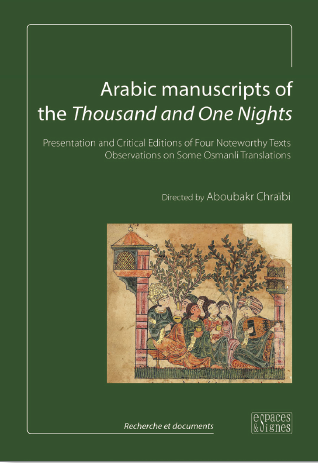
Arabic manuscripts of the Thousand and One Nights


Arabic manuscripts of the Thousand and One Nights is a new book recently published by Harback, Directed by Aboubakr Chraïbi.
I've uploaded the book's information on Scribd below along with its table of contents.
The field of Nights studies concerned with Arabic manuscripts of the work has long been missing a comprehensive, updated bibliography and overview of these manuscripts. As such it will be a vital resource for Nights scholarship, particularly as that scholarship continues to take a more global and comparative view of the story collection.


Monday, December 16, 2013

"The Story of the Forty Maidens": Introduction and Translation by Bruce Fudge


Here is the story "The Story of the Forty Maidens": Introduction and
Translation by Bruce Fudge.

You can find it here - Middle Eastern Literatures, 2013
Vol. 16, No. 2, 203–216, http://dx.doi.org/10.1080/1475262X.2013.843262

Or download it here - https://www.academia.edu/5439477/The_Story_of_the_Forty_Maidens_Introduction_and_Translation

From the story's intro:

"The story is found in the collection known as Kitāb al-ḥikāyāt al-ʿajıb̄ a wa-l-akhbār algharıb̄
a (The Book of the Wonderful Stories and Strange Reports), which is based on a
unique Istanbul manuscript (Aya Sofya 3397), first brought to orientalist attention by
Helmut Ritter and subsequently published by Hans Wehr in 1956.2 Although 42 tales
are listed, only 18 are preserved in what seems to have been the first of two volumes.
Four of these are very similar versions of tales found in the Thousand and One Nights:
‘the Barber’s Six Brothers’ (in the Ḥikāyāt as ‘Story of the Six’), ‘Jullanār of the Sea’,
‘Abū Muḥammad the Lazy’ and ‘Jubayr ibn ʿUmayr and the Lady Budūr’ (which
appears in the Ḥikāyāt as ‘ʿUmayr bin Jubayr’). As the Istanbul manuscript has been
dated to the early eighth/14th century, it is at least as old as the oldest known manuscript
of the Nights, that used by Antoine Galland and the basis of the critical edition of Muhsin
Mahdi. This makes it of particular interest for the history of the Thousand and One Nights
itself as well as Arabic narrative in general."

Saturday, March 19, 2011

Burton & the Wortley-Montague & Oxford


I chanced upon several letters in the Appendix of Volume 4 of Burton's Supplemental Nights which throw light on the situation he faced when he was in the process of translating his Nights.

He wanted to have the copy of the Wortley-Montague manuscript sent to him at the India Office from the Bodleian Library at Oxford but the board members at the library were refusing, despite Burton's insistence that he was not going to translate the racier passages or stories.

This may explain why ultimately there are several stories in the Wortley-Montague (including "Ali and his Large Member" of my previous post here: http://journalofthenights.blogspot.com/2011/03/ali-and-his-large-member.html) that Burton did not translate.

He also mentions the incident in the preface to the edition.  It's in my Volume 4 but may be in different volumes depending on which edition you are looking at, the initial set of his translations from the Wortley-Montague.

He tried to have a student who didn't know Arabic at Oxford copy the manuscript for him (like drawing the same characters without knowing what they said), but the student quit after a few days!

He eventually had someone photocopy (or the equivalent?) the manuscript for him and send it to him.  Ali and his large member is MIA however.  I'll have to check the 1995 German edition of the manuscript to see if Ali is there.   I have been officially sidetracked, though not completely off my own tracks.  Studying the Nights is truly like digging in the sand.

Many thanks to Jamie at USC for the question.

There is another English edition by Jonathan Scott translated before Burton which also includes stories from the Wortley-Montague but which, and I'm not certain here and only relying on Burton's notes so far, seem to be edited for cleanliness and not to contain an extensively translated amount of stories either.

Burton's letters are interesting to read in this volume.  He's quite upset with the library and ends the Appendix A of this volume with a scathing indictment of Oxford in general!

Some snippets from his letters:

"I may note that the translated tales (as may be seen by Scott's version) contain nothing indelicate or immoral; in fact the whole MS. is exceptionally pure.  Moreover, the MS., as far as I can learn, is never used at Oxford" (281).

"I am acquainted with many of the public libraries of Europe, but I know of none that would throw such obstacles in the way of students" (282).

The reason for the story not being translated by Burton, however, may not be related to the incident with the Bodleian after all.  As I look at Volume 5 I see his rebuttal to the library's refusal of lending the manuscript to him.  He writes to them that, because of their refusal, he's now going to put in all of the racy material, even overdoing it!

He also dedicates the Volume to them:

"TO THE CURATORS OF THE BODLEIAN LIBRARY, OXFORD:  Especially REVD. B. PRICE and PROFESSOR MAX MULLER."

He writes to them:

"Gentlemen,
I take the liberty of placing your names at the head of this Volume which owes its rarest and raciest passages to your kindly refusing the temporary transfer of the Wortley Montague MS. from your pleasant library to the care of Dr. Rost., Chief Librarian, India Office.  As a sop to "bigotry and virtue," as a concession to the "Scribes and Pharisees," I had undertaken, in case the loan were granted, not to translate tales and passages which might expose you, the Curators, to unfriendly comment.  But, possibly anticipating what injury would thereby accrue to the Volume and what sorrow to my subscribers, you were good enough not to sanction the transfer - indeed you refused it to me twice - and for this step my Clientele will be (or ought to be) truly thankful to you.

I am, Gentlemen,
Yours obediently,
RICHARD F. BURTON

BODLEIAN LIBRARY, August 5th, 1888."

"Ali and his large member" is not in this volume under this title.  Perhaps the story is inside another story or titled differently by Burton?  Perhaps the story doesn't really exist??

PS RICHARD F BURTON IS NOW ON TWITTER!:  http://twitter.com/#!/mirzaburton

Saturday, February 5, 2011

Call for Papers - MLA 2012

Call for Papers at the 2012 MLA Convention in Seattle

Manuscripts & Sources of The 1001 Nights

Unconfirmed special session proposal on the sources or manuscripts of The 1001 Nights. Papers examining, in detail, one specific version of the Nights will be especially considered.

Abstracts by 11 March 2011; Michael Lundell (lundell@gmail.com).

Please pass along to anyone who might be interested!

Wednesday, December 29, 2010

The Galland Manuscript

The Galland Manuscript

This image is allegedly of the Galland manuscript from the wikipedia page for the Nights.  There is no attribution though so who knows.  It's the most often used image online of the manuscript though.


The often-called “Galland manuscript” is an Arabic language manuscript of the Nights in the Bibliotheque nationale in Paris France.  Its call numbers at the library are MSS arabes 3609, 3610 and 3611.  It is the oldest manuscript of the Nights in any language that contains any stories and people have dated it to somewhere around the 15th century AD.  This date is disputed however and some think it is written earlier in the 14th century.

It’s not clear who the author or scribe is (yet! maybe you can find out) or exactly where or when or how this manuscript came into being (besides allegedly being sent from Syria to Galland in 1701).

There are three volumes.

There are 282 “nights” and around 35 stories. 

I've never read about a certain title on this manuscript nor are the stories individually titled (can someone verify or refute this?) yet they are segmented into numbered “nights.” On the picture above however each section clearly says "Alf Layla wa Layla" in Arabic.

These volumes were in Antoine Galland’s personal library and he appeared to use them as the primary (but far from only) source for the beginning volumes of his French translation of the Nights which were titled Mille et une Nuits (1704-1717). (Thanks to JC for the dates of publication).

Galland received the Arabic manuscript volumes in 1701 while in France.  A friend seems to have brought from Syria, but was in France with them when Galland acquired them.

Galland had requested that his colleagues look for the complete or original Nights after he translated a stand-alone version of “Sindbad” (aka “Sinbad the Sailor and Sinbad the Porter” or several other related sounding/spelled titles) from Arabic into French that someone told him was a part of a larger body of work (the Nights).

The last story is known generally (though has several different spelling and other title variants) as “The Tale of Qamar al-Zaman and Budur” and does not have an ending.

In 1984 Muhsin Mahdi, a professor at Harvard, published an edited and collated version of this Arabic manuscript (along with a completed version of “Qamar al-Zaman”) in which he attempts to portray the oldest and most authentic Nights as anyone knew them.  His out of print three volume set from Brill consists of the manuscript, several essays in English, several indexes in Arabic including an intensive comparative index and a descriptive chapter of old manuscripts of the Nights and an introduction in Arabic of his theories regarding the various origins of the Nights.  This set is expensive when found but many major university libraries have a copy or have access to one.

In 1990 WW Norton published an English translation by Husain Haddawy of Mahdi’s recension titled The Arabian Nights consisting only of these oldest stories. 

In 2004 Claudia Ott translated this manuscript (using Mahdi’s edition) into German.  It was published in Europe under the title Tausendundeine Nacht.

Muhsin Mahdi writes about the acquisition of the G-Manuscript:

"He must have come across the information about the Nights some time between 25 February and 13 October 1701.  On the first date, he wrote a letter to Pierre-Daniel Huet referring to 'Sindbad':  'I also have another little translation from Arabic, stories just as good as the fairy tales published these last years in such profusion.'  On the second date, he wrote another letter to Huet where he mentions the Nights:  'Three of four days ago,' he says, 'a friend from Aleppo residing in Paris informed me by letter that he has received from his country a book in Arabic I had asked him to get for me.  It is in three volumes, entitled . . . The Thousand Nights.'  Even before seeing the manuscript, he describes the acquisition as 'a collection of stories people recite in the evening in that country [Syria]. . . . I asked this friend to keep it for me until I come to Paris, the cost of purchase and shipping being ten écus.  It will be something with which to amuse myself during the long [winter] nights.'

He traveled from Caen to Paris in December 1701 and took possession of the three-volume Syrian manuscript of the Nights (A) that would be named after him.  He seems to have started almost immediately to translate the work; for, in August 1702, he wrote to Gisbert Cuper:  'I have finished a clean copy of a six-hundred page work. . . . I had started it this year [1702] upon my return to Paris [in December 1701], working on it only after dinner. . . . This other work . . . is entitled The Thousand and One Nights, Arab Tales, Translated into French. . . . A thousand and one Nights!, and I have only finished seventy; this can give you an idea of the length of the entire work.'  By the end of the summer of 1702, therefore, he had finished a clean copy of the first two volumes of his Nuits, covering the first sixty-nine Nights or slightly more than the first volume of his Arabic manuscript.  These were published early in 1704, followed by the next four volumes in 1705.  The first volume contained the dedication to the Marquise d'O and an Avertissement exposing his appreciation of the Nights."

(19-20, Mahdi, The Thousand and One Nights, Leiden:  EJ Brill, 1995).

Feel free to add related bibliographic info (a short bibliography is listed below) and or other info or corrections in the comments section (or just email me too).  I’ve put only English and one Arabic resource below but I’m certain there are many more I’ve missed in all languages.


Table of Contents

Here is the table of contents as rendered in English by Husain Haddawy:

Prologue:  The Story of King Shahrayar and Shahrazad, His Vizier's Daughter

     The Tale of the Ox and the Donkey
     The Tale of the Merchant and His Wife

The Story of the Merchant and the Demon

     The First Old Man's Tale
     The Second Old Man's Tale

The Story of the Fisherman and the Demon

     The Tale of King Yunan and the Sage Duban
     The Tale of the Husband and the Parrot
     The Tale of the King's Son and the She-Ghoul
     The Tale of the Enchanted King

The Story of the Porter and the Three Ladies

     The First Dervish's Tale
     The Second Dervish's Tale
          The Tale of the Envious and the Envied
     The Third Dervish's Tale
     The Tale of the First Lady, the Flogged One

The Story of the Three Apples

     The Story of the Two Viziers, Nur al-Din Ali al-Misri and Badr al-Din Hasan al-Basri

The Story of the Hunchback

     The Christian Broker's Tale:  The Young Man with the Severed Hand and the Girl
     The Steward's Tale:  The Young Man from Baghdad and Lady Zubaida's Maid
     The Jewish Physician's Tale:  The Young Man from Mosul and the Murdered Girl
     The Tailor's Tale:  The Lame Young Man from Baghdad and the Barber
          The Barber's Tale
               The Tale of the First Brother, the Hunchbacked Tailor
               The Tale of the Second Brother, Baqbaqa the Paraplegic
               The Tale of the Third Brother, Faqfaq the Blind
               The Tale of the Fourth Brother, the One-Eyed Butcher
               The Tale of the Fifth Brother, the Cropped of Ears
               The Tale of the Sixth Brother, the Cropped of Lips

The Story of Nur al-Din Ali ibn Bakkar and the Slave-Girl Shams al-Nahar

The Story of the Slave-Girl Anis al-Jalis and Nur al-Din Ali ibn-Khaqan

The Story of Jullanar of the Sea

The Story of Qamar al-Zaman (missing an ending in the G-manuscript)


Bibliography Specific to the Galland Manuscript:
 

English

Wollamshram's Blog Post on the breakdown of the volumes and contents of Galland's (French) Nights:

http://wollamshram.wordpress.com/2011/01/01/galland%E2%80%99s-mille-et-une-nuit/


See also the relevant sections from the following books:

The Arabian Nights Handbook
by Robert Irwin

Eastern Dreams by Paul McMichael Nurse

And the entries “Manuscripts,” “Galland, Antoine,” and “Sindbad the Seaman” in The Arabian Nights Encyclopedia (volumes one and two) edited by Ulrich Marzolph and Richard van Leeuwen.

Reynolds, Dwight F. "A Thousand and One Nights: a history of the text and its reception." Arabic Literature in the Post-Classical Period. Eds. Roger Allen and D. S. Richards. Cambridge University Press, 2006.

Grotzfeld, Heinz.  “The Age of the Galland Manuscript of the Nights:  Numismatic Evidence for Dating a Manuscript.”  Journal of Arabic and Islamic Studies I:  50-64.  1996-7.

And the following oldies but goodies from Duncan MacDonald:

“The Story of the Fisherman and the Jinni:  Transcribed from Galland’s MS of ‘The Thousand and One Nights.’”  Orientalische Studien:  Th.  Noldeke zum 70.  Geburtstag gewidmet, ed. by Carl Bezold.  Giessen:  Toepelmann, 357-383.  1906.

“Lost Manuscripts of the ‘Arabian Nights’ and a Projected Edition of that of Galland.”  Journal of the Royal Asiatic Society:  219-221.

“A Preliminary Classification of Some Mss. of the Arabian Nights.”  A Volume of Oriental Studies:  Presented to Edward G. Browne on his 60th Birthday.  Eds. Thomas W. Arnold and Reynold A. Nicholson.  Cambridge:  Cambridge UP, 304-321.  1922.

“The Earlier History of the Arabian Nights.”  Journal of the Royal Asiatic Society, 353-397.

“A Bibliographical and Literary Study of the First Appearance of the Arabian Nights in Europe.”  Library Quarterly 2:  387-420.  1932.

In Arabic Muhsin Mahdi has a collection of manuscript descriptions including the Galland manuscript in volume II of The Thousand and One Nights from the Earliest Known Sources.  Leiden:  Brill.  1984.

Thursday, August 19, 2010

New Manuscript Discovery for 101 Nights

I'm not too familiar with the story collection known as "One Hundred and One Nights" which, according to The Arabian Nights Encyclopedia originated from North Africa and contains some elements of the familiar stories from some of the oldest versions of the 1001 Nights.  If someone can point toward a copy for sale somewhere online or elsewhere I'd appreciate it (it's only in Arabic and French I believe).

From the encyclopedia:  "The work is structured as a frame story resembling the frame story of the Arabian Nights, with the motifs of adultery, the cycle of marriage and execution, and the figures of Shahrazad and Dinarzad (Dunyazad).  The collection contains eighteen stories.  These stories are similar to well-known stories in the Arabian Nights such as Uns al-Wujud and al-Ward fi'l-Akman, Ni'ma and Nu'm, The Three Apples, and Hasan of Basra.  The Mi'at Layla wa-layla also contains versions of the Book of Sindbad, The Ebony Horse, and The City of Brass" (vol 2 594-5).

The encyclopedia also says these stories were written in the 19th century, well after the main known Arabic versions of the 1001 Nights.

A recent news article featuring German scholar and translator Claudia Ott suggests that she has found a manuscript of the 101 Nights which predates even Galland's Syrian manuscript which is, if true, one of the most significant manuscript findings in the Nights' history.  The article suggests that this 101 Nights' manuscript dates from the 13th century which, apart from the Nabia Abbott fragment, would be the oldest manuscript for any stories relating to the 1001 Nights.

Whether or not this manuscript is indeed as old as they are claiming and what stories it contains remains to be seen but it is a very very interesting development nonetheless.

Here is the link to the article/interview with Ott:  http://www.qantara.de/webcom/show_article.php/_c-310/_nr-761/i.html

from the article:

"However, there are divergent opinions on the relationship between the two books. There is already a critical edition of the "101 Nights" based on much more recent manuscripts from the late 18th and early 19th centuries, whose publisher, Mahmud Tarshuna, claims that "101 Nights" is the substantially older and more original text. His argument uses motifs from the framing narrative to claim that the "101 Nights" is closer to the Sanskrit and Pali texts of their old Indian literary sources than "1001 Nights" is.

But we also have some very old sources for "1001 Nights". In Chicago in 1949, a double sheet of paper was discovered in a pile of papyrus that had been brought back from Egypt. It bore the title "Thousand Nights" ("alf layla" in Arabic) and the beginning of a description of one night. The double sheet is a palimpsest dated 879. Its origins are evidently not Egyptian, where papyrus was still preferred to paper at that time, but Syrian."

-----------------------------------

"This also fits with what the Arabic sources tell us. Contemporary booksellers reports make it clear that a complete version, with 1000 Nights, must already have existed in the 9th century. Over the centuries several fragments of the work have been found, each of which have probably looked rather different from one another. The 1001st night was probably added in the early 12th century. In a notebook, discovered by chance in the Geniza in a synagogue in Cairo, there is the first known mention of the complete title on a lending note from around 1150: "Alf layla wa-layla" – "The Thousand and One Nights".

So I am convinced that "101Nights" and "1001 Nights" are part of a parallel tradition. "The Hundred and One Nights" and "The Thousand and One Nights" were contemporaneous with one another, the one probably better known in the west, the other in the east of the Arabian world. But all of this is something that requires further investigation. A magnificent chapter in Arab literary history has just been reopened."