Showing posts with label 18th. Show all posts

Sunday, July 14, 2013

Goethe - The Sufferings of Young Werther & the Magnetic Mountain

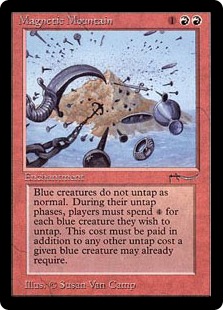
Magic the Gathering's Magnetic Mountain Card from its Arabian Nights set


Our hero Werther, of Goethe's great The Sufferings of Young Werther, has a Nights-esque moment, referencing the Magnet Mountain -

Book One - Entry July 26

"More than once I have made the resolve not to see her so often.  If one could only keep such a resolution!  Every day I succumb to temptation and made a sacred promise to myself:  tomorrow you will just stay away; and when tomorrow comes I find another irresistible reason for going, and before I realize it I'm with her.  Either she said the evening before:  'You will come tomorrow, won't you?' - who could stay away after that? - or she gives me an errand to do and I find it appropriate to bring her the answer myself, or the day is altogether too beautiful, so I walk to Wahlheim and when I have got that far, it's only another half hour to her!  I am too near her atmosphere - zoom, I'm there.  My grandmother used to tell a tale about the magnetic mountain. Ships that came too close to it suddenly lost all their iron; the nails flew to the mountain and the poor wretched crew perished amid the collapsing planks."

From page 29 of Harry Steinhauer's Norton translation (paperback 1970)

And from Arabian Nights Entertainments  - The History of the third Calendar, a King's Son (edition here - books.google.com/books?id=khkHAAAAQAAJ)


Having spoke thus, he fell a crying like a man who foresaw unavoidable ruin; his despair put the whole ship’s crew in a terror.  I asked him what reason he had thus to despair?  He told me, the tempest, which we had out-liv’d, had brought us so far our of our course, that to-morrow about noon we shall come near to that black place, which is nothing else but the black mountain, that is a mine of adamant, which at this very moment draws all your fleet towards it, by virtue of your iron and nails that are in your ships; and when we come to-morrow at a certain distance, the strength of the adamant will have such a force, that all the nails will be drawn out of the sides and bottoms of the ships, and fasten to the mountain, so that your vessels will fall to pieces, and sink to the bottom.  And as the adamant has a virtue to draw all iron to it, whereby its attraction becomes stronger, this mountain on the side of the sea is all covered over with nails, drawn out of an infinite number of vessels that have perished by it; and this preserves and augments its virtue at the same time

(151)


From Burton's translation (The Third Kalandar's Tale) -

"O my Prince," answered he, "know that we lost our course on the night of the storm, which was followed on the morrow by a two days' calm during which we made no way, and we have gone astray eleven days' reckoning from that night, with ne'er a wind to bring us back to our true course. Tomorrow by the end of the day we shall come to a mountain of black stone hight the Magnet Mountain, for thither the currents carry us willy-nilly. As soon as we are under its lea, the ship's sides will open and every nail in plank will fly out and cleave fast to the mountain, for that Almighty Allah hath gifted the loadstone with a mysterious virtue and a love for iron, by reason whereof all which is iron traveleth toward it. And on this mountain is much iron, how much none knoweth save the Most High, from the many vessels which have been lost there since the days of yore. The bright spot upon its summit is a dome of yellow laton from Andalusia, vaulted upon ten columns. And on its crown is a horseman who rideth a horse of brass and holdeth in hand a lance of laton, and there hangeth on his bosom a tablet of lead graven with names and talismans." And he presently added, "And, O King, none destroyeth folk save the rider on that steed, nor will the egromancy be dispelled till he fall from his horse."

Friday, October 26, 2012

Wordsworth and the Nights

From The Prelude, by William Wordsworth ( published in 1850 but worked on during the poet's entire life, and a must read for everyone, wiki: http://en.wikipedia.org/wiki/The_Prelude)


I had a precious treasure at that time,
A little yellow canvass-covered book,
A slender abstract of the Arabian Tales;
And when I learned, as now I first did learn
From my companions in this new abode,
That this dear prize of mine was but a block
Hewn from a mighty quarry — in a word,
That there were four large volumes, laden all
With kindred matter — ’twas in truth to me
A promise scarcely earthly. Instantly
I made a league, a covenant with a friend
Of my own age, that we should lay aside
The monies we possessed, and hoard up more,
Till our joint Savings had amassed enough
To make this book our own. Through several months
Religiously did we preserve that vow,
And spite of all temptation hoarded up,
And hoarded up; but firmness failed at length,
Nor were we ever masters of our wish.

And afterwards, when, to my father’s house
Returning at the holidays, I found
That golden store of books which I had left
Open to my enjoyment once again,
What heart was mine! Full often through the course
Of those glad respites in the summertime
When armed with rod and line we went abroad
For a whole day together, I have lain
Down by thy side, O Derwent, murmuring stream,
On the hot stones and in the glaring sun,
And there have read, devouring as I read,
Defrauding the day’s glory — desperate –
Till with a sudden bound of smart reproach
Such as an idler deals with in his shame,
I to my sport betook myself again.

From The Prelude, Book V, li. 482-515

Saturday, March 19, 2011

Burton & the Wortley-Montague & Oxford


I chanced upon several letters in the Appendix of Volume 4 of Burton's Supplemental Nights which throw light on the situation he faced when he was in the process of translating his Nights.

He wanted to have the copy of the Wortley-Montague manuscript sent to him at the India Office from the Bodleian Library at Oxford but the board members at the library were refusing, despite Burton's insistence that he was not going to translate the racier passages or stories.

This may explain why ultimately there are several stories in the Wortley-Montague (including "Ali and his Large Member" of my previous post here: http://journalofthenights.blogspot.com/2011/03/ali-and-his-large-member.html) that Burton did not translate.

He also mentions the incident in the preface to the edition.  It's in my Volume 4 but may be in different volumes depending on which edition you are looking at, the initial set of his translations from the Wortley-Montague.

He tried to have a student who didn't know Arabic at Oxford copy the manuscript for him (like drawing the same characters without knowing what they said), but the student quit after a few days!

He eventually had someone photocopy (or the equivalent?) the manuscript for him and send it to him.  Ali and his large member is MIA however.  I'll have to check the 1995 German edition of the manuscript to see if Ali is there.   I have been officially sidetracked, though not completely off my own tracks.  Studying the Nights is truly like digging in the sand.

Many thanks to Jamie at USC for the question.

There is another English edition by Jonathan Scott translated before Burton which also includes stories from the Wortley-Montague but which, and I'm not certain here and only relying on Burton's notes so far, seem to be edited for cleanliness and not to contain an extensively translated amount of stories either.

Burton's letters are interesting to read in this volume.  He's quite upset with the library and ends the Appendix A of this volume with a scathing indictment of Oxford in general!

Some snippets from his letters:

"I may note that the translated tales (as may be seen by Scott's version) contain nothing indelicate or immoral; in fact the whole MS. is exceptionally pure.  Moreover, the MS., as far as I can learn, is never used at Oxford" (281).

"I am acquainted with many of the public libraries of Europe, but I know of none that would throw such obstacles in the way of students" (282).

The reason for the story not being translated by Burton, however, may not be related to the incident with the Bodleian after all.  As I look at Volume 5 I see his rebuttal to the library's refusal of lending the manuscript to him.  He writes to them that, because of their refusal, he's now going to put in all of the racy material, even overdoing it!

He also dedicates the Volume to them:

"TO THE CURATORS OF THE BODLEIAN LIBRARY, OXFORD:  Especially REVD. B. PRICE and PROFESSOR MAX MULLER."

He writes to them:

"Gentlemen,
I take the liberty of placing your names at the head of this Volume which owes its rarest and raciest passages to your kindly refusing the temporary transfer of the Wortley Montague MS. from your pleasant library to the care of Dr. Rost., Chief Librarian, India Office.  As a sop to "bigotry and virtue," as a concession to the "Scribes and Pharisees," I had undertaken, in case the loan were granted, not to translate tales and passages which might expose you, the Curators, to unfriendly comment.  But, possibly anticipating what injury would thereby accrue to the Volume and what sorrow to my subscribers, you were good enough not to sanction the transfer - indeed you refused it to me twice - and for this step my Clientele will be (or ought to be) truly thankful to you.

I am, Gentlemen,
Yours obediently,
RICHARD F. BURTON

BODLEIAN LIBRARY, August 5th, 1888."

"Ali and his large member" is not in this volume under this title.  Perhaps the story is inside another story or titled differently by Burton?  Perhaps the story doesn't really exist??

PS RICHARD F BURTON IS NOW ON TWITTER!:  http://twitter.com/#!/mirzaburton

Friday, March 18, 2011

Ali and his Large "Member"


A visitor has asked me an interesting question, they are interested in the story "Ali and his large member" (yes that kind of member), but I don't know too much about it.

I did some very minor looking around and this is what I came up with, I'll have to double-check my Burton but I think he didn't translate all of the stories from the Wortley-Montague manuscript, although this one seems like something he may have been interested in taking a look at. 

It's only in the so called Wortley Montague manuscript, not found in any other version before it.  This was published in, or dated to 1764, according to the Arabian Nights Encyclopedia.

The story is on pages 682-692.

This (Arabic) manuscript is in the Bodleian Library.  It's not a translation and has Wortley-Montague's name attached to it because he owned it. 

There is  a German translation of the Nights from this manuscript by Felix Tauer that may contain this story, according to the Encyclopedia.  I think the title is Neue Erzählungen aus den Tausendundein Nächten.


Apart from that there doesn't seem to be any other mention of the story in any other version of the Nights.

Anyone else know something more/different?

Thanks,

Michael

Note to Aristotle's Poetics by Henry James Pye (1792)

I came across this while browsing some other related topic (the original topic I've long forgotten!).  Perhaps where you end up is just as well as where you begin.

It is a short essay with references to the Nights by Henry James Pye, from 1792. (http://en.wikipedia.org/wiki/Henry_James_Pye)

Its title is "Note to Aristotle's Poetics" and I found it at this website on English poetry:

http://spenserians.cath.vt.edu/TextRecord.php?action=GET&textsid=35239


"EVEN IN THE EPOPEE THE FABLES SHOULD HAVE A DRAMATIC FORM, AND RELATE TO ONE ENTIRE AND COMPLEAT ACTION, WHICH HAS A BEGINNING, A MIDDLE, AND AN END.

It has been already observed that in every fictitious tale, independently of technical rules, it is impossible to keep up the attention and interest of the piece without confining the time of the fable within a certain boundary. This rule of nature is confirmed by the practice of all our good novel writers. I will not only instance the novels of Fielding, who as being a scholar, and rather fond of shewing he was, may be supposed to display his acquaintance with the precepts of the Stagirite, or rather the models from whence they are drawn: but those of Richardson, of Mrs. Smith, and of Miss Burney, who cannot be supposed to be influenced by any pedantry of this kind. Even in those novels which are written on what Dr. Beattie calls the historical plan, such as Peregrine Pickle and Roderick Random, though they begin with the infancy of the hero, they by no means compleat his life. The first events are rather preparatory to, than part of the main object of the story, the body of which, or to speak dramatically, the plot, is the love of the principal characters, as the solution of it, or catastrophe, is their marriage.

The mode used by the orientals to give a species of unity to their complicated fables is very singular. Of this the Arabian Nights exhibit a curious specimen. A general story, or ground-work for the whole, is first formed. This is the bloody vow of the sultan in consequence of the sultana's infidelity, the generous resolution of the vizir's daughter, and her final triumph. Into this the other stories are woven, but the introductory tale is continually brought to our recollection by the conversation that precedes the narrative of every night. Every story is besides branched out into a number of others, to each of which it serves as a common bond of union, as the original one is to the whole.

By this strange contrivance an appearance of general unity is kept up without the least of that effect which is proposed as the consequence of unity; as the mind is disagreeably perplexed by the broken chain of the narrative, expectation is suspended till all interest in the fable is lost, and instead of perspicuity confusion is produced. This arrangement is preserved in the first half of Mr. Galland's translation. In the latter part he has given such separate stories as struck him, without dividing the nights, or preserving any connexion between them, except the catastrophe of the leading fable. Mr. Andrews in his Anecdotes, gives a humorous reason for M. Galland's change of conduct. But I believe the principal cause of it was the length of the original work, which he has greatly abridged, as will be apparent on comparing the number of nights in that part of his translation where they are noticed, which is a full half of his work, with the compleat number of a thousand and one.

Dr. Beattie seems to question the authenticity of this work. I think the reason he urges; (the French features given it by M. Galland,) can have no weight with a person who has ever read a French translation from any language. Whoever will compare this work even through the medium of a French translation with the many WESTERN oriental tales, to which it has given birth, will see strong marks of original and real character. But I believe the authenticity of this work is capable of stronger proof. I have been informed that Professor White has a compleat copy in Arabic. Mr. Richardson also, in his Arabic Grammar, has printed one of the fables at length in the original language, and quoted verses from another which are not translated by M. Galland, though the tale from which they are taken is.
This mode of narration was adopted by Ariosto, and was copied from him by our countryman Spenser.

As for Ariosto, his imagination is so brilliant, his subject so wonderfully varied

From grave to gay, from lively to severe:

there is such a mingled vein of sublimity, and humour, running through the whole work, that notwithstanding the many absurdities it contains, and such a total want of connexion in the incidents, that to enable the reader at all to follow the thread of the scattered tales, the commentators have been obliged to have recourse to inartificial assistance or marginal references; yet we can hardly wish it to have been in any respect different from what it is. But as the work of Spenser is entirely of a serious cast, our taste is more fastidious, and indeed the attempt at uniformity, which is avowed by the author, causes us to be more disgusted both with the want of it in the Cantos that are preserved, and the apparent inadequacy of the whole plan proposed, had it been compleatly carried into execution. The unity produced by the introduction of a general kind of secondary hero pervading the whole, must have been very awkward and very uninteresting. Prince Arthur engaged as an assistant to the several allegorical heroes in their respective adventures, would have exactly resembled the pentathlete, as described by Plato, who, however skilful he might be in the contest with those who like himself were trained to the practice of various exercises, was always inferior to those athletes who applied themselves to one only, in that particular exercise."